TP200
A compact, module-changing probe that uses strain-gauge mechanisms for higher accuracy and longer life than kinematic touch-trigger probes.
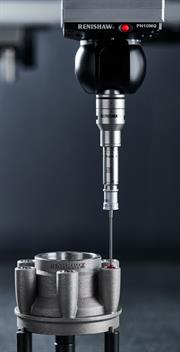
The TP200 system components are:
- TP200 or TP200B probe body (the TP200B is a variant with increased vibration tolerance)
- TP200 stylus module - choice of fixed overtravel forces: SF (standard force) or LF (low force)
- PI 200-3 probe interface
- SCR200 stylus change rack
There is also an EO module (extended overtravel) which has the same overtravel force as the SF but provides increased operating range and protection in the probe Z-axis.
Features and benefits
- Strain-gauge technology offers excellent repeatability and precision 3D form measurement
- Zero reseat errors
- No lobing effect
- 6-way measuring capability
- Stylus reach of up to 100 mm (GF styli)
- Rapid probe module changing without the need to re-qualify the stylus tips
- Life of >10 million triggers
TP200 / TP200B probe body
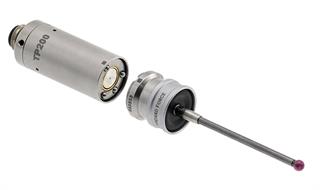
The TP200 probe uses micro strain gauge transducers to deliver excellent repeatability and accurate 3D form measurement even with long styli.
The sensor technology gives sub-micron repeatability and eliminates the lobing characteristics encountered with kinematic probes. The solid state ASIC electronics within the probe ensure reliable operation over millions of trigger points.
The TP200B uses the same technology as TP200 but has been designed to have higher tolerance to vibration. This helps to overcome the problem of 'air' trigger generation which can arise from vibrations transmitted through the CMM or when using long styli with faster positioning speeds.
Please note that we do not recommend the use of TP200B with the LF module or cranked / star styli.
Specification summary | TP200 | TP200B |
|---|---|---|
Principal application | DCC CMM where high accuracy is required. | As TP200 but where 'air' trigger events occur. |
Sense directions | 6-axis: ±X, ±Y, ±Z | 6-axis: ±X, ±Y, ±Z |
Unidirectional repeatability (2σ µm) | Trigger level 1: 0.40 µm (0.000016 in) Trigger level 2: 0.50 µm (0.00002 in) | Trigger level 1: 0.40 µm (0.000016 in) Trigger level 2: 0.50 µm (0.00002 in) |
XY (2D) form measurement deviation | Trigger level 1: ±0.80 µm (0.000032 in) Trigger level 2: ±0.90 µm (0.000036 in) | Trigger level 1: ±1 µm (0.00004 in) Trigger level 2: ±1.2 µm (0.000047 in) |
XYZ (3D) form measurement deviation | Trigger level 1: ±1 µm (0.00004 in) Trigger level 2: ±1.40 µm (0.000056 in) | Trigger level 1: ±2.50 µm (0.0001 in) Trigger level 2: ±4 µm (0.00016 in) |
Repeatability of stylus change | With SCR200: ±0.50 µm (0.00002 in) max. Manual: ±1 µm (0.00004 in) max. | With SCR200: ±0.50 µm (0.00002 in) max. Manual: ±1 µm (0.00004 in) max. |
Trigger force (at stylus tip) | XY plane (all modules): 0.02 N Z-axis (all modules): 0.07 N | XY plane (all modules): 0.02 N Z-axis (all modules): 0.07 N |
Overtravel force (@ 0.50 mm displacement) | XY plane (SF / EO module): 0.2 N to 0.4 N XY plane (LF module): 0.1 N to 0.15 N Z-axis (SF / EO module): 4.90 N Z-axis (LF module): 1.60 N | XY plane (SF / EO module): 0.2 N to 0.4 N XY plane (LF module): 0.1 N to 0.15 N Z-axis (SF / EO module): 4.90 N Z-axis (LF module): 1.60 N |
Weight (probe sensor and module) | 22 g (0.78 oz) | 22 g (0.78 oz) |
Maximum extension (if on a PH10 PLUS series head) | 300 mm (11.81 in) | 300 mm (11.81 in) |
Maximum recommended stylus length (M2 styli range) | SF / EO module: 50 mm (1.97 in) steel to 100 mm (3.94 in) GF LF module: 20 mm (0.79 in) steel to 50 mm (1.97 in) GF | SF / EO module: 50 mm (1.97 in) steel to 100 mm (3.94 in) GF LF module: 20 mm (0.79 in) steel to 50 mm (1.97 in) GF |
Mounting method | M8 thread | M8 thread |
Suitable interface | ||
Stylus module changing rack | ||
Stylus range |
TP200 stylus modules
The stylus module is mounted on the TP200 / TP200B probe body via a highly repeatable magnetic kinematic joint, providing a rapid stylus changing capability and probe overtravel protection.
There are three modules available, with two different overtravel forces.
Module | SF (standard force) | LF (low force) | EO (extended overtravel) |
|---|---|---|---|
Application | General use. | Small diameter stylus balls or where minimum force is essential. | Extra overtravel to enable the CMM to stop safely from higher probing speeds. |
Comments | Styli up to 100 mm long and ball diameter > 1 mm. | Balls less than 1 mm diameter. | Same overtravel force as SF. Extra 8 mm of overtravel in probe Z-axis. |
SCR200 changing rack
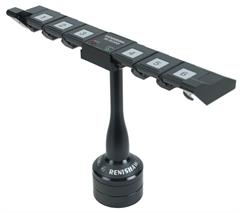
The SCR200 provides automatic, high speed changing of up to six TP200 stylus modules. The SCR200 is powered by the separate probe interface, PI 200-3, and provides features to facilitate safe stylus changing. The SCR200 is available in low force and standard force kits, where each kit comprises one SCR200 plus three stylus modules of the same force.
Extended warranty
For peace of mind a 3-year warranty is available for your new CMM products during the first 3 months from purchase. Contact your vendor.
Product information
You may also be interested in...
You are currently looking at the TP200 probe. You may also be interested in learning about the SP25M scanning probe…