Our segments
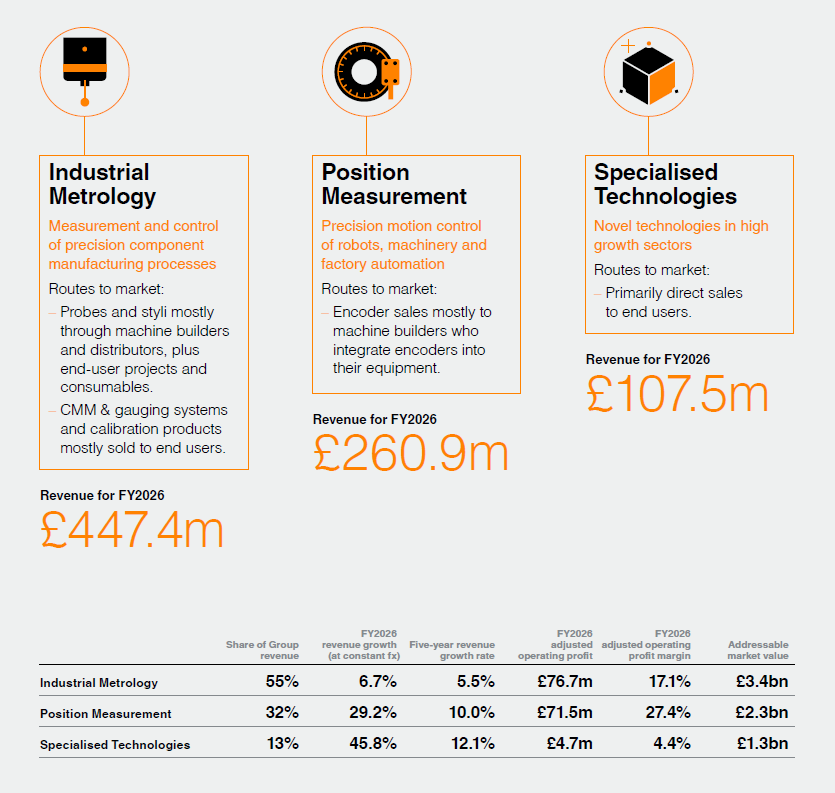
Our business is organised in three segments: Industrial Metrology, Position Measurement and Specialised Technologies.
Together, they help Renishaw pursue innovation-led growth in established and emerging markets with a combined addressable value of £7bn. Each segment director is a member of the Executive Committee, supporting Renishaw's strategic focus and sharing examples of good practice from their part of the Group.
Below we provide an overview of each of their products, customers and trends that we saw in FY2026 that were impacting demand.
Industrial Metrology
Industrial Metrology (IM) is our largest segment, making sensors, measurement systems and software that allow customers to precisely measure machines and machined parts, generate inspection reports and control their production machines. Our products are used throughout the production process – directly on metal-cutting machines, on the shopfloor nearby, and in quality assurance laboratories. Our calibration systems are used to fine-tune the production and set-up of precision machines, and to check their continued operation in a range of applications. Our industrial automation products enhance the accuracy and productivity of robots, which are increasingly used within machining operations.
Our customers
Our customers work in key manufacturing sectors, including aerospace and defence, automotive, and consumer electronics, and rely on our products to support highly repeatable, efficient processes to make complex parts with tight tolerances. We provide sensors to manufacturers of machines that service these sectors, as well as complete metrology systems to end users. Because of our long track record of innovation, reliable products and excellent support, many of our customers have been working with us for decades. We're proud of the close relationships we have with them to help develop solutions that meet their needs and commercial goals.
The trends affecting our markets in FY2026
We are seeing significant global investment in defence applications, as well as increased reinvestment in internal combustion engine manufacturing, particularly in the USA. Demand for power generation to run data centres is having an impact, with more diesel and turbine generators being manufactured to provide back-up power sources. In FY2026 we continued to see lower overall demand from machine tool builders, but with that demand concentrated on higher-value, 5-axis machines. This benefits Renishaw since our reputation for precision and reliability in fully automated production means our products are often chosen for these machines.
More broadly, the trend towards more automation and ‘smart' factories continues to grow across our sectors, with an increasing number of customers incorporating measurement into shopfloor processes. Our newer metrology software is supporting this trend, incorporating functionality that allows data from measurement machines and computer numerically controlled (CNC) machines across a factory to be used to improve the automation of process control.
Sustainability remains a growing issue as our customers develop their own goals and targets. Our automated measurement tools help, since they improve manufacturing efficiency, which reduces both waste material and energy use.
In a climate of geopolitical uncertainty, security of supply remains high on the agenda and customers continue to diversify their supply chains across multiple regions. Our global subsidiary network helps us respond to this trend by enabling the rapid transfer of engineering knowledge and experience around the world.
Position Measurement
Position Measurement (PM) makes products that enable customers to improve control and precision in their machines in a wide variety of applications. Our position encoders provide electronic feedback on machine motion to ensure accuracy and enable automated operation.
Our customers
Our customers work in highly demanding sectors that require speed, precision and reliability, and we work closely with them to develop products that meet their specific needs for a wide range of applications. This includes semiconductor chip production, flat panel display manufacturing and robotics.
Our encoders are used at all stages of the semiconductor production process, from manufacturing silicon wafers to packaging and testing individual devices. The semiconductor sector is highly cyclical and we are currently seeing a ‘super cycle', which is driving very high levels of investment across the entire supply chain.
We maintain a strong pipeline of new products to serve these rapidly changing markets, and carefully manage our established product lines to continuously improve or retire them as needed.
Many of our experts have worked for Renishaw for a long time and their knowledge has helped us build deep, longstanding relationships. Our credibility is reinforced by the fact we use PM products to manufacture our IM and ST products.
The trends affecting our markets in FY2026
One of the biggest trends to affect the segment in FY2026 was the exponential rise in demand for AI processing in data centres, which relies heavily on microelectronics, semiconductors and optical couplers.
We also continued to benefit from increasing levels of industrial automation, including rising demand from the battery manufacturing sector.
As already noted, growing global investment in aerospace and defence applications over the past 12 to 18 months has driven significant interest in our new ASTRiA inductive encoder.
More generally, the segment continues to be affected by broader economic and geopolitical trends, with export control an area of continued complexity. However, these same factors present new opportunities as industrialised nations continue to invest in reshoring semiconductor manufacturing to reduce their reliance on the dominant geographical sources of supply.
Similarly, competition from low-cost manufacturers, particularly in Asia, continues to grow. Our reputation for innovation and quality helps us but we are committed to increasing automation in our own production processes to meet the cost, flexibility and lead times necessary to remain competitive.
We are using highly automated processes to build some of our newer large-volume products. This will enable us to flex our manufacturing output to respond to the inherently cyclical demand in some of our key end markets, including semiconductor manufacturing.
Specialised Technologies
Our Specialised Technologies (ST) segment provides capital equipment and after-sales support in three main areas: additive manufacturing (AM), spectroscopy and neurological.
Our AM machines incorporate high-powered lasers to make complex 3D metal components. They are supported by our software solutions, which enable them to be integrated with other ‘smart' manufacturing technologies, such as computer-aided design tools.
Our spectroscopy product division designs and manufactures high-powered Raman spectrometers that are used to analyse the chemical and structural properties of materials. We are a leading global manufacturer of laboratory Raman microscopes, and provide highly configurable products that allow our customers to meet their specific needs. Our current focus is on products that are versatile and easy-to-use and targeted at maturing industrial applications.
Our neurological product division makes neurosurgical robots, accessories and planning software to support clinicians in planning and delivering neurological procedures with a high degree of precision and predictability.
Our customers
Our AM customers primarily work in the aerospace and defence and healthcare sectors. Cost-per-part remains a barrier to widespread adoption in other more price-sensitive, highly agile markets, like consumer electronics, but interest there is growing, thanks to our longstanding focus on manufacturing machines that boost productivity and maximise cost effectiveness. We aim to be a trusted partner with scalable solutions and close relationships between our AM application and service engineers and key customers.
Our Raman spectrometers are used by customers in a range of sectors, including academia, pharmaceuticals, high-tech materials research and development, forensics and cultural heritage. We're seeing increasing interest in industrial sectors as we introduce new, easier-to-use instruments like our new Strada microscope.
In neurological, we provide hospitals with faster, more precise surgical products that help increase procedural efficiency and support accurate delivery of neurological interventions. Our products also help surgeons to plan a procedure ahead of surgery, saving time in the operating theatre.
The trends affecting our markets in FY2026
We saw particularly strong demand for our AM products from the aerospace and defence sector in FY2026, where the design freedom and productivity the technology offers makes it ideal for printing intricate, high-value components. Demand from the medical sector remains strong, too.
We saw rising interest in emerging AM markets, including the consumer electronics sector. This is particularly exciting as we see significant volume production applications for our products. We use AM in our own processes and therefore understand the challenges associated with adopting AM, including the need for a cultural shift to optimise part design for additive rather than subtractive manufacturing. For example, we're using the technology to manufacture some of the components in our Strada microscope.
Academia is our biggest spectroscopy market. However, it relies heavily on government funding, and continues to be affected by geopolitical uncertainty. Industrial applications offer exciting growth opportunities, often seeded by previous research activities. We see increasing demand in areas like battery development and semiconductors, where our systems can be used to monitor production processes. Demand is also rising in healthcare to support studies for early cancer detection, diagnosing diseases and drug discovery. Our broader product portfolio is positioned to take advantage of these emerging opportunities.
Demand continues to grow for image-guided and robotic-assisted neurosurgical procedures that support greater procedural precision and workflow efficiency. As previously announced, we believe these opportunities would be better realised by finding a new, more strategically aligned owner for the business.