Challenges in the robotics industry
Robots are exceptional at doing the dull, dirty, or dangerous tasks that put humans at risk. They can repeat the same motion thousands of times with unwavering consistency, working around the clock without fatigue. Adopting industrial robots on a large scale frees the human work force to take on more fulfilling, safer tasks that require the creativity and problem-solving skills that robots lack.
But there are challenges to industrial automation adoption which are holding businesses back.
Challenges which slow industrial automation adoption
Set-up
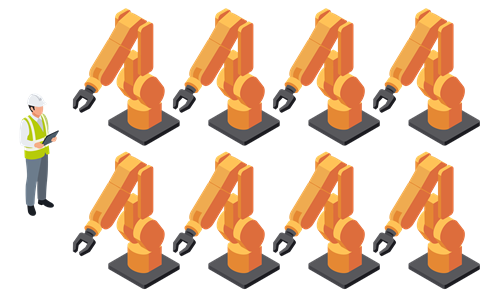
Commissioning a robot cell remains a highly manual process in many environments. Engineers must rely on their own skill, judgement, and experience to verify that a cell is correctly configured and behaving as expected. This introduces variability, slows deployment, and makes scaling automation more complex.
As organisations increase the number of robots on their factory floors, the pressure to streamline set-up grows. Every manual step adds friction. Every subjective check creates uncertainty. It is fast becoming a key priority for teams to standardise, accelerate and de-risk robot commissioning.
Recovery
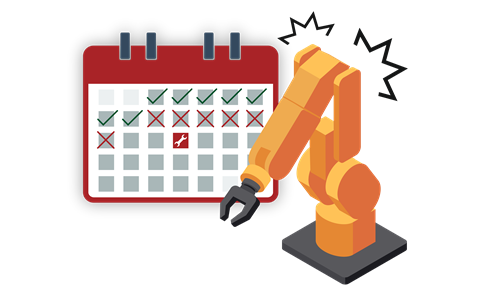
Unplanned stoppages aren't just inconvenient — they're costly. When a robot cell fails, teams need to diagnose what went wrong, restore the robot's working condition, and validate the fix. Without structured recovery methods, this process can stretch far longer than it should.
Whether caused by collision, drift, operator error, or unforeseen variation, the path back to productivity is often manual and time consuming. Minutes can easily turn into hours. As production waits, costs rise and confidence drops. Manufacturers increasingly recognise that rapid, reliable cell recovery isn't just a maintenance goal — it's a competitive advantage.
Drift
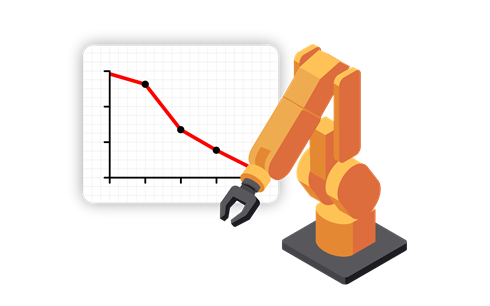
Robot systems don't stay perfectly stable over time. Mechanical components wear, temperatures shift, loads vary, and small deviations accumulate. These tiny changes may be imperceptible day-to-day until they suddenly become a source of error, downtime or scrap.
The challenge? Many operations have no structured way to record or quantify these changes. Without continuous visibility of how a robot's performance evolves, it's easy for drift to go unnoticed until it becomes a bigger, more expensive problem. Organisations are increasingly seeking ways to measure performance trends, compare them over time, and act proactively rather than reactively.
Inaccuracy
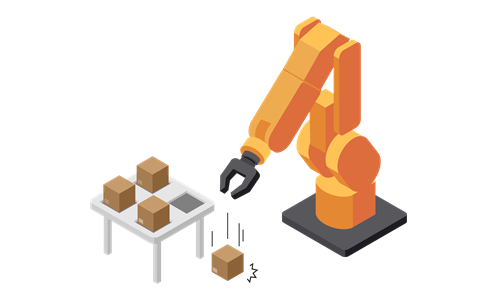
Industrial robots are known for doing the same thing very precisely — but repeating an inaccurate motion still results in an inaccurate process. Many systems are highly repeatable yet fall short on absolute accuracy, especially in applications that demand tight tolerances, precise paths, or exact spatial alignment.
This creates a gap between expected and actual performance. In many cases, robots could be more accurate — the mechanical capability exists — but operators lack the tools or insights needed to unlock that potential. Improving absolute accuracy can transform process quality, reduce corrections, and expand what's possible with automation.
Service
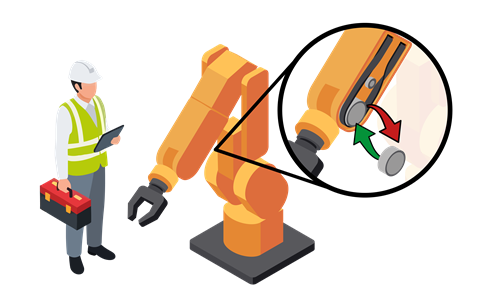
Traditional robot maintenance is often based on human perception: listening for unusual noises, smelling overheating components, feeling vibration, or relying on an engineer's intuition. While experience is valuable, this approach is subjective, inconsistent, and difficult to scale across teams, sites, and geographies.
Manufacturers are now shifting toward objective, data-driven service models. Instead of assessing robot health by “feel,” they want measurable diagnostics, repeatable evaluations, and insights that support confident decisions. This move toward quantifiable service isn't just modernisation — it's the foundation for reducing unplanned failures and optimising lifecycle performance.
How the RCS product series addresses challenges in the robotics industry
Even the best robots have blind spots.
They are difficult to program in the first place — the process can be slow, manual, and heavily dependent on operator skill. They can't fix themselves when something drifts out of specification, nor can they reliably tell you when a subtle problem is emerging. Although industrial robots are highly repeatable, they're not inherently accurate, and that gap between repeatability and true positional accuracy can limit process quality or introduce hidden inefficiencies. When issues do arise, robots rarely issue early warnings; instead, small deviations often go unnoticed until they become downtime, scrap, or safety concerns.
The RCS product series addresses the challenges that limit industrial automation adoption.
It bridges the gap between what robots can do and what operations truly need with smarter diagnostics, structured insight, and modern calibration tools.
Now, we can unlock more accuracy, more reliability, and more autonomy from the same robotic hardware.
Contact our sales team today
Complete the form below to find out more information and speak to an expert.