'Right first time' robot set-up with RCS L-90
Background
MTC is a part-membership, part-government-funded Research and Technology Organisation based in Coventry. They have developed a novel idea they have termed, ‘Factory in a Box'.
Designed in response to the need to bring manufacturing processes to remote sites, MTC developed bespoke robotic cells inside moveable shipping containers. The objective is that these ‘factories in a box' can be relocated to isolated or hazardous locations where more risky tasks can be under taken with minimal human interaction.
Chief Engineer, Technology, Digital Engineering Group, Steve Cartwright, explains: “When there's a risk to humans working on a dangerous operation, we can actually put a shipping container with manufacturing capability into a remote area that's detached from humans, and it eliminates that risk.”
MTC's latest Factory in a Box venture is named ‘Project Charge' where two industrial ABB robots are busy dismantling electric batteries, ready for recycling, in a shipping container the size of your average bathroom. Liam Bradley-Smith is a Technical Specialist with MTC says: “Batteries are getting more advanced. They're fitting more cells in the same space. They're really squeezing in the capability to allow for more drive time and quicker charge time. And all of that means it's getting more complex to dismantle them.”

By fitting more cells in the same space cars using EV batteries allow for more drive time and faster recharging.
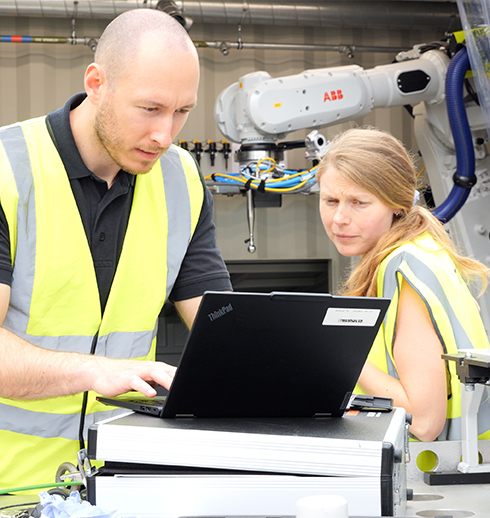
Tamas Barany and Josie Götz updating the robot's tool centre point (TCP) with new accurate data from RCS Software Suite
Challenge
Demand for EV batteries is growing in the UK, with manufacturing capacity expected to reach nearly 110 GWh per year in 2030 according to the Faraday Institution. To protect the environment, EV batteries need to be disposed of using sustainable processes.
The Society of Motor Manufacturers and Traders estimates that by 2030 the UK alone will have 28,000 tonnes of batteries requiring recycling, rising to 235,000 tonnes by 2040. This is where the MTC comes in. Josie Götz, Senior Research Engineer for MTC says: “There's going to be a big glut of batteries coming onto the after-use, the second use, or onto the recycling market, and they present a challenge for dismantling due to the hazardous material or risk of thermal events and fires.
To facilitate the concept of the cell, MTC needed to be able to set-up robots quickly and consistently after relocation. Cartwright adds: “We have a lot of experience of launching robots. It's not always easy. It's grown in technology and it's grown in capability. Pressures are always there in manufacturing to get the robots up and running as soon as possible.”
Solution
The RCS L-90 is a linear ballbar designed to speed up the set-up
of industrial robots. It brings Renishaw's expertise in metrology, to
industrial robotics.
Designed for six-axis robots, the RCS L-90's impact lies in fast tool and part frame set-up, tool frame verification, joint repeatability tests, and path performance tests for robots undertaking intricate work. The RCS L-90 assesses the accuracy of a robot through health check routines and can recover a robot without reteaching.
Götz explains: “The RCS L-90 allows us to quickly check where the TCP is, if there's any misalignment with the robot TCP, if we have a crash in the robot, or if we've moved the cell to a different location. And that gives us the confidence to be able to run the paths and the programs that the robot has already been preprogrammed to do.”
Bradley-Smith adds: “The idea being, before we start, after any move, let's just do a check. Let's just make sure these robots are performing as we intend. They're calibrated; They're behaving themselves; nothing's drifted. And then using it as what I would call ‘validation' over time. We are ensuring continual performance of the robot.”
He continues, “And, at the moment, we're using this Factory in a Box for stripping down battery cells and electric vehicles. But in the future, we'll repurpose this for another activity, as required. And again, we'll have those calibration activities hopefully embedded as our normal day-to-day to ensure these robots are performing as we'd like them to be.”
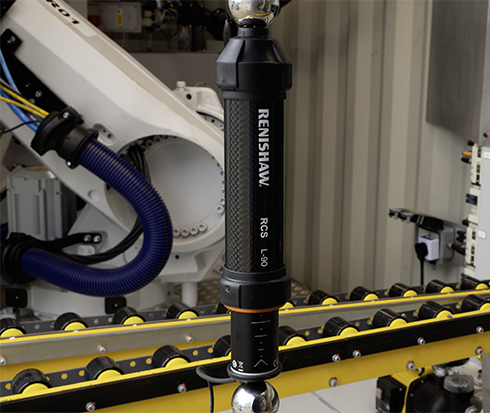
An RCS L-90 ballbar attached to an ABB robot inside a shipping container, ready to run robot set-up tests
The value here is time.
Steve Cartwright — Chief Engineer, Technology, Digital Engineering Group
Results
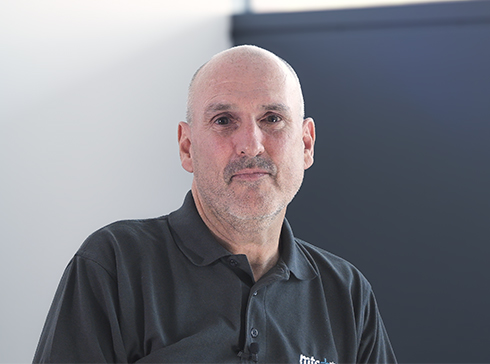
Steve Cartwright — Chief Engineer, Technology, Digital Engineering Group
Cartwright explained: “It's time, and the reliability of the data that's going to come out of this situation. To ensure that when we do start, we can go into production without having to chase tolerance problems around the system. My wish for the future is that this technology is embedded into robotic systems so it becomes a universal set-up. So, from switch-on you can go and calibrate it by pressing the home button.”
A sentiment which Bradley-Smith agrees with: “Since implementing this technology, we're seeing a right first time set-up. We're pressing go on the robots and they're where they should be. And the program's running automatically. I'm not there with an external measurement system tracking the robot to ensure it's in the right place. It's just streamlined.”
“Therefore, productivity and throughput just go straight up by implementing them. This will be the new normal for us. We will integrate this with all our robotic cells where there is the chance for things to drift over time and ensure that consistent approach going forward.”
Documents
-
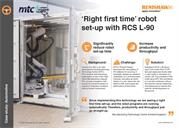 Case study: 'Right first time' robot set-up with RCS L-90 - Manufacturing Technology Centre
‘Factory in a Box’ is an idea developed by the Manufacturing Technology Centre (MTC). The concept emerged to fulfil a need for industrial robotics in remote or hazardous locations without human involvement. In this case study understand how The RCS L-90 portable in-field toolkit gave MTC the confidence to move containers without the need for manual robot reteaching.
[5.8MB]