OMBI automates part set-up and corrects pivot point error with Renishaw’s RMP24-micro probe and AxiSet™ Check-Up software
Background
Founded in 1946, OMBI is an Italian machine tool manufacturer recognised for its expertise in designing and manufacturing machines for the goldsmith, jewellery, and watchmaking sectors.
There has been strong growth in jewellery manufacturing, driven by the adoption of advanced 5-axis machining technology. To meet this demand, OMBI introduced their latest 5-axis machine, the OM200.
With over 75 years of experience, OMBI is an established provider of chain making machines and compact CNC machines. OMBI takes an innovative approach, combining traditional jewellery craftsmanship with advanced technology to streamline, automate, and control production processes.
OMBI takes pride in their in-house manufacturing processes which produce every component for their chain-making and 5-axis CNC machines.
Their workshop operates over 40 CNC machines, equipped with Renishaw probes for precise part set-up and inspection. Quality is at the heart of OMBI's operations.
For more than a decade, Renishaw technology has been integrated into OMBI's manufacturing processes, ensuring accuracy and consistency at every stage.
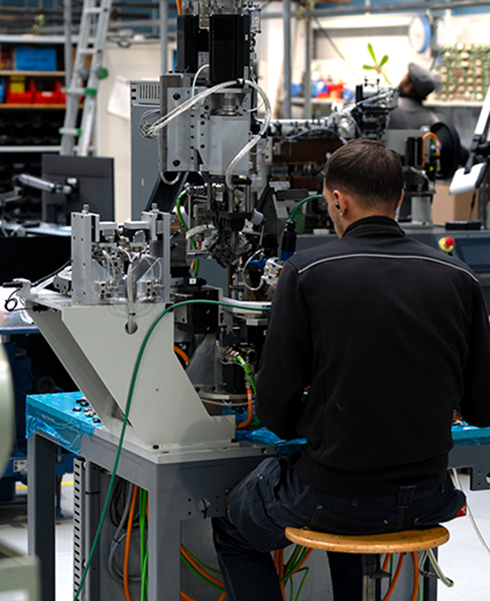
We make our machines in-house. That way, we know that our machines meet the highest standards of precision and quality. Renishaw shares these values of quality and technological standards. This makes them a great fit as a supplier.
Valentina Montanaro, CEO, OMBI (Italy)
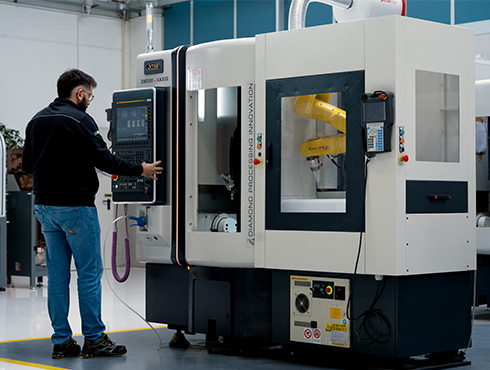
OMBI broadened their portfolio with the launch of an ultra-compact 5-axis machine, the OM200.
The OM200 is designed for high-speed, end-to-end, precision machining and assembly of small, intricate, and often complex components such as watch faces, bangles, bracelets and rings.
Designing an ultra-compact machine capable of sub-micron precision left little room for compromise. Any additional technology integrated into the OM200 must enhance accuracy and reliability while fitting seamlessly within its compact working envelope.
Challenge
OMBI's customers for the OM200 are some of the biggest luxury jewellery producers in the world, renowned for crafting the most intricate and sought-after pieces.
Delicate and high-value materials: These parts can be made from high-value, either soft or delicate materials, such as gold, platinum, titanium or special alloys. Extreme care is required when working with such delicate materials throughout the manufacturing process.
Intricate and complex shapes: The parts being machined are typically complex 3D shapes with precise forms, which are extremely difficult to measure accurately and repeatably.
Tight tolerances and high-precision: The jewellery industry demands exceptional precision, and perceived quality is of the highest importance. Every component manufactured must be within tolerance.
Quality assurance, high labour costs and specialist knowledge: Any compromise in quality could manifest in cosmetic defects or poorly fitted components, ultimately resulting in costly scrap and rework. Quality assurance traditionally falls upon highly skilled craftspeople, creating bottlenecks and training risks – where specialist knowledge must be transferred to new recruits.
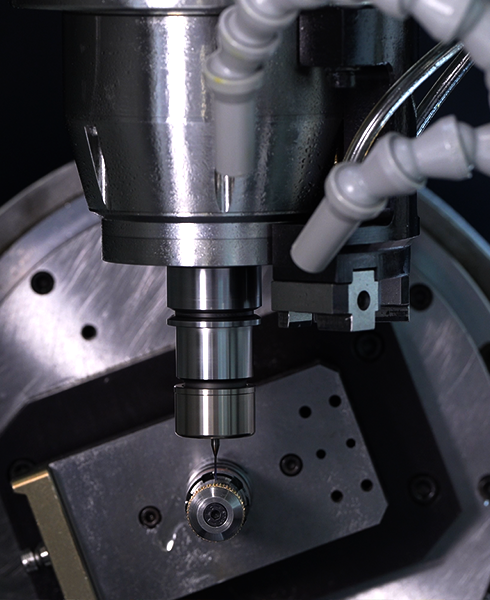
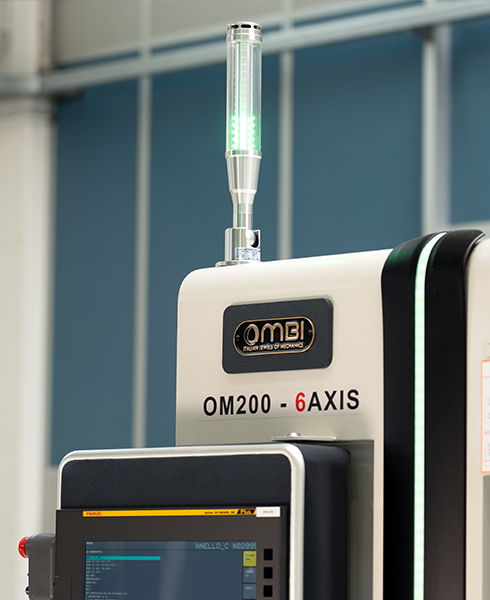
The OM200 replicates traditional processes used in the manufacture of jewellery using a modern 5-axis CNC capability. However, such an advanced machine comes with its own challenges.
Compact, micro-sized machine: The small size of the OM200 is a challenge for fitting equipment such as probes due to limited space and line-of-sight limitations within the machine. This means that radio-based wireless communication between the probe and the machine essential.
Part set-up positional error: Before machining begins, the part position needs to be located. When setting up parts in a machine, any alignment or position error will lead to error in machining.
Multi-axis pivot point error: Multiple pivot points within 5-axis machines like the OM200 can compound together and lead to machining error. These errors can be caused by factors such as thermal expansion and regular wear. For all precision machines, maintaining accurate rotary axis alignment is essential for making sure parts are produced within tolerance.
Solution
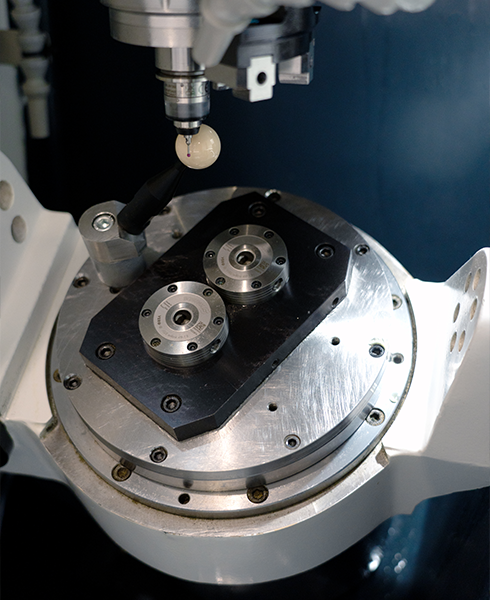
OMBI needed to incorporate advanced probing technology into the OM200 to address part set-up and pivot point error challenges. Renishaw's RMP24-micro was the most obvious choice for this, as the world's smallest wireless machine tool probe.
Overcoming space limitations: The OM200 is a very compact machine with a small working envelope. Measuring at just 24 mm in diameter and 31.4 mm in length, RMP24-micro fits perfectly within compact CNC machines such as the OM200.
In addition to its size advantages, RMP24-micro is also a highly accurate and repeatable inspection probe, with a submicron repeatability of 0.35µ 2σ.
Radio communication: In such compact machines, ensuring line-of-sight between the probe and interface can be a challenge. RMP24-micro does not need a direct line-of-sight between the probe and interface, because it communicates using radio transmission.
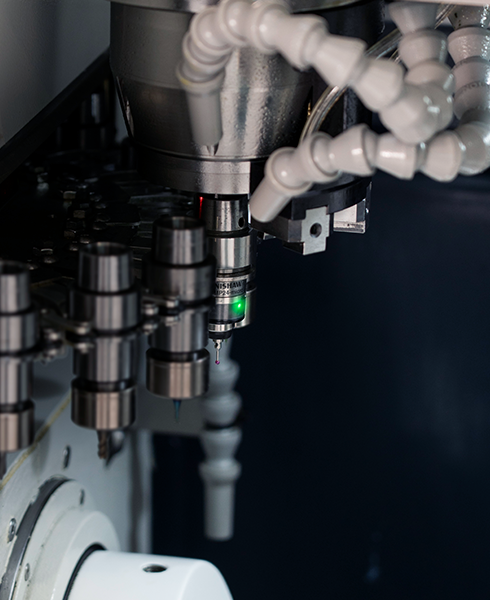
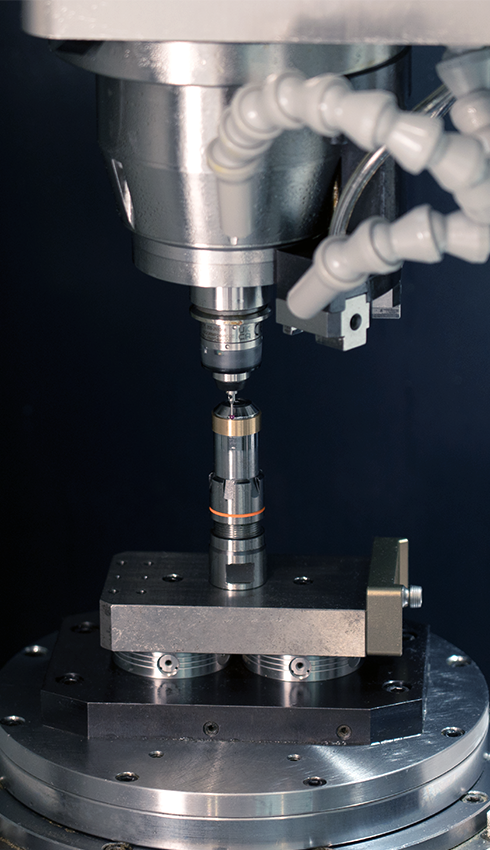
OMBI's customers work with high-value materials, which must meet tight tolerances and remain undamaged throughout production. To meet these demands, RMP24-micro is used as a probing solution to help automate and maintain part quality and consistency.
Fast, accurate and reliable part set-up: RMP24-micro performs rapid part set-up by capturing the co-ordinates of a workpiece and sending them directly to the machine tool controller. These points are used to determine datums and align angles without the need for human intervention.
Ultra-low trigger force probe: RMP24-micro's low trigger force offers a feather-light touch when making contact with a surface, helping to minimise the risk of surface damage or part deflection. This is essential for touch-trigger probing with delicate materials which are typically soft, and would otherwise result in costly part damage.
Micro-kinematic probe with superior 3D accuracy: RMP24-micro utilises a micro-kinematic probing mechanism to perform part set-up and inspection of intricate 3D shapes and contours to submicron levels. These shapes are commonly found in high-end jewellery manufacturing, meaning RMP24-micro's metrology performance fulfils the needs of this market.
Easy to use probing cycles for immediate results: Renishaw's Inspection Plus software makes programming cycles for probing easy. The software provides operators with a set of ready-to-use cycles for rapid probing adoption and immediate results.
OMBI also wanted to enhance the performance of the OM200 by using Renishaw's AxiSet™ Check-Up system for analysing the performance of the machine's rotary axes.
Identifying and compensating for rotary axis error: RMP24-micro is used with AxiSet Check-Up to identify poor machine alignment, geometry and pivot point errors. These can cause extended process setting times and non-conforming parts. It identifies and compensates for errors caused by incorrect machine set-up, collisions or wear.
Simplified pivot point error correction process: The AxiSet Check-Up app simplifies the process of correcting rotary axis errors. It collects reference measurements and updates machine parameters automatically, removing the need for manual measurements, and eliminating risk of human error.
Results

80% reduction in part set-up times

30% reduction in scrap and rework

Improved machining tolerances from 0.05 mm to 0.01 mm

Total confidence in machining process
Since using the RMP24-micro probe for part set-up in the OM200, we have seen up to an 80% reduction in set-up times.
Valentina Montanaro, CEO, OMBI (Italy)
OMBI and OM200 users have integrated RMP24-micro and Renishaw's Inspection Plus software into their part set-up process. Since automating part set-up, machining results have significantly improved.
Significantly reduced set-up times: When RMP24-micro is used to automate part set-up, OMBI has seen up to an 80% reduction in part set-up times. This frees up operators to focus on higher-value tasks and reduces production bottlenecks.
Quality costs reduced and stabilised: Using the RMP24-micro probe for part set-up means each part is machined highly accurately, and easily achieves the desired tolerances. This leads to a reduction in rework requirements, scrap and therefore, the cost of quality per part is significantly reduced.
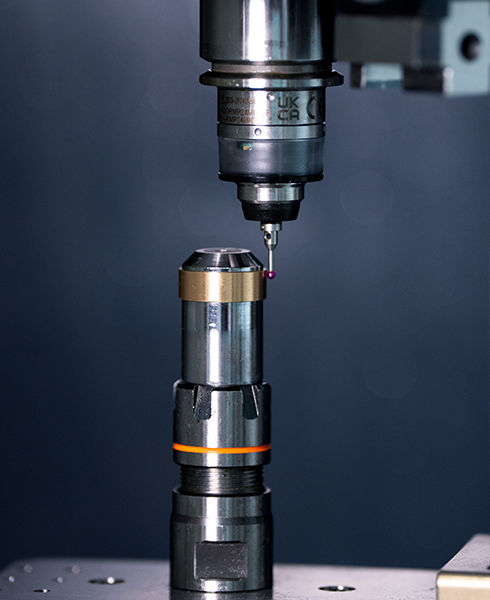
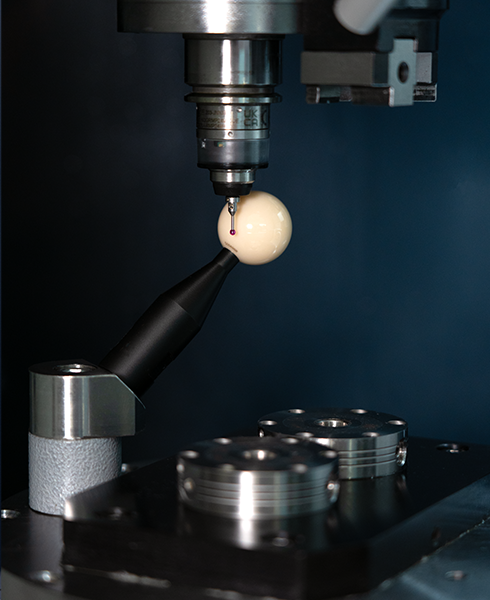
RMP24-micro and AxiSet Check-Up software have provided operators with a reliable and consistent way to correct axis misalignment and update rotational pivot points on the OM200.
Significant reduction in scrap: By using RMP24-micro with AxiSet Check-Up to compensate for pivot point error, there has been a considerable reduction in scrap by 30%. OMBI and their customers can easily measure rotary axis errors as they occur, before they impact machining.
Tighter tolerances achieved: Before machining begins, RMP24-micro with AxiSet Check-Up is used to compensate for pivot point error. This has led to an improved part tolerance from 0.05 mm to 0.01 mm. Tighter tolerances are now achievable, allowing OMBI's customers to take on even more challenging jobs.
Before, the tolerance for machining parts was 0.05 mm. Since we started using RMP24-micro with AxiSet Check-Up, machining tolerance has improved to 0.01 mm.
Valentina Montanaro, CEO, OMBI (Italy)
Conclusion

When we produce a machine, we know it will perform at its absolute best. By using Renishaw's RMP24-micro, AxiSet Check-Up, and Inspection Plus software with the OM200, our customers get a machine they can trust to deliver high-quality, in-tolerance parts.
Valentina Montanaro, CEO, OMBI (Italy)