How do position encoders improve gimbal performance?
Gimbals are often used in systems that require the rotation of an object or sub-system about one or more axes. Applications of gimbals include camera stabilisation for aerial photography and videography, maritime radar systems, and ground-based telescopes for observation and precise tracking of celestial objects.
To rotate a gimbal to a desired orientation both reliably and accurately, precise angle feedback is required. Position encoders are high-precision sensors that measure the angular position of a gimbal's axes (pan, tilt, and roll), providing real-time feedback to a gimbal's control system.
Traditionally, some rotating axes have relied on low-precision sensors like resolvers or potentiometers for angle reporting. Position encoders provide significantly higher measurement accuracy, making them ideal for the most demanding gimbal applications. Encoders are immune to mechanical errors such as backlash and often feature non-contact designs, where the rotating component never touches the stationary part. This eliminates wear and friction which are common issues in mechanical systems.
Factors such as size, weight, measurement performance, and environmental stability are crucial considerations when designing gimbals. Renishaw offers a range of encoder solutions to meet these requirements.
- Optical encoders provide excellent angle measurement performance, with fine resolution, high accuracy and superior repeatability.
- Inductive encoders offer robust metrology performance from a lightweight low-profile package.
- Magnetic encoders deliver reliable angle measurement, even in harsh environments, with the lowest weight and smallest form factor.
This application note explores how encoders are used in common gimbal applications; radar systems, telescopes, camera mounts, and UAV (Unmanned Aerial Vehicle) imaging.
Gimbals in radar systems
One important gimbal application is radar systems designed to detect and classify aircraft using a Frequency Modulated Continuous Wave (FMCW) radar or similar technologies. These systems typically include antennas for transmitting and receiving radar signals, along with processing circuitry that generates radar plots and tracks from the received signals. The radar plots provide critical information such as range, azimuth, radial velocity, and return energy, which are used to identify and classify detected objects.
Position encoders play a vital role by delivering precise pan-position feedback for the rotating antennas. The pan encoder is mounted on the horizontal support of the radar system and provides high-precision rotary feedback. This encoder data is combined with the radar signal data to accurately determine the position of detected objects within the radar's coverage area. The feedback from the encoder enables the radar system to generate accurate and reliable plots and tracks, which are essential for distinguishing Unmanned Aerial Vehicles (UAVs) from other objects, such as birds.
 Satellite dishes for telecommunications
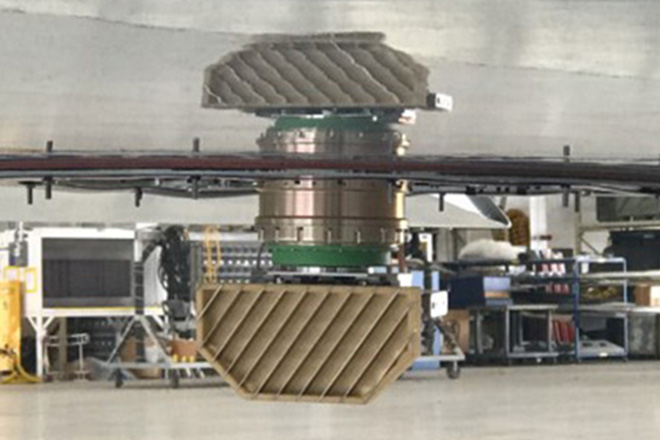 RF antenna and gimbal assembly on the belly of an aircraft
Example application
Monostatic radar systems house both the transmitter and receiver at the same location. These systems incorporate a stack of components that includes a Radio Frequency (RF) array feed at the base, and a series of lenses mounted on two-axis gimbals driven by directdrive motors. Each motor is mechanically coupled to a RESOLUTE ETR (Extended Temperature Range) encoder with a 75 mm low-profile RESA ring scale, providing precise feedback on lens rotation.
These encoders significantly enhance antenna system performance, delivering marked improvements in positioning accuracy and resolution. Their robust and reliable feedback is critical for rapid, accurate beam pointing and scanning operations.
Alternatively, some high-performance brushless DC motors integrate a built-in rotary position sensor, such as the AksIM-2 rotary absolute magnetic encoder. This direct integration enhances motor control accuracy and reliability in a cost-effective way.
Gimbals in optical telescopes
Another important gimbal application is in optical telescopes designed for viewing celestial objects in both visible and infrared (IR) light. In one design, the telescope features a primary mirror and a moveable secondary mirror, which can be positioned concentrically over the primary mirror or offset from it.
An IR turret is a rotating structure that moves multiple instruments or gratings into the telescopes optical beam path primarily to separate and detect IR light. In high-performance telescopes, position encoders measure the angular positions of both the secondary mirror and the IR turret relative to their respective axes.
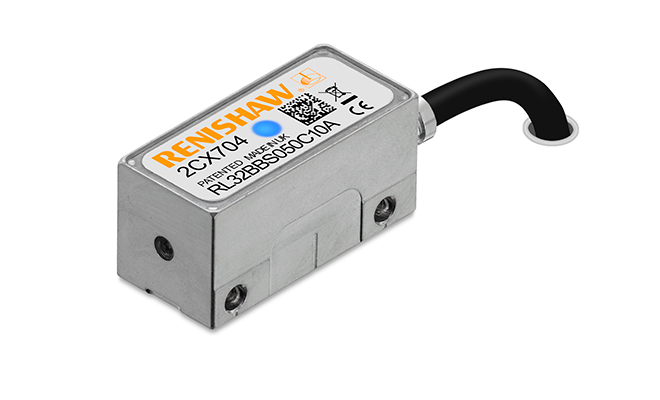
This position feedback is essential for the control system to achieve accurate alignment and positioning of the optical elements, enabling focal length and field-of-view adjustments.
Position encoders are also mounted to the telescope's tilt (right ascension) and pan (declination) axes for tracking and pointing. They continuously measure the telescope's position and movement as it tracks celestial objects across the sky, ensuring accurate pointing and compensation for the Earth's rotation.
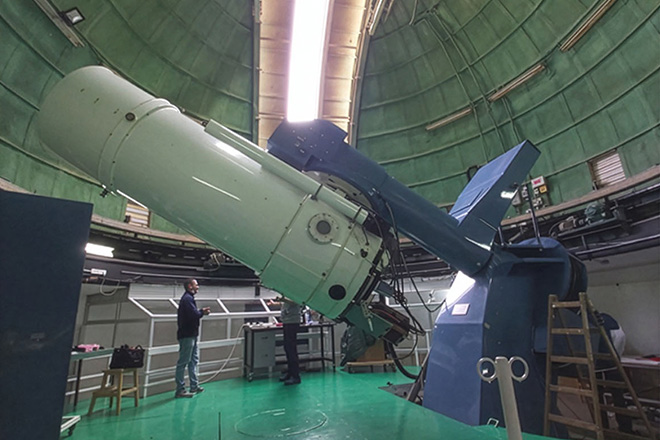 A one-metre telescope in an observatory
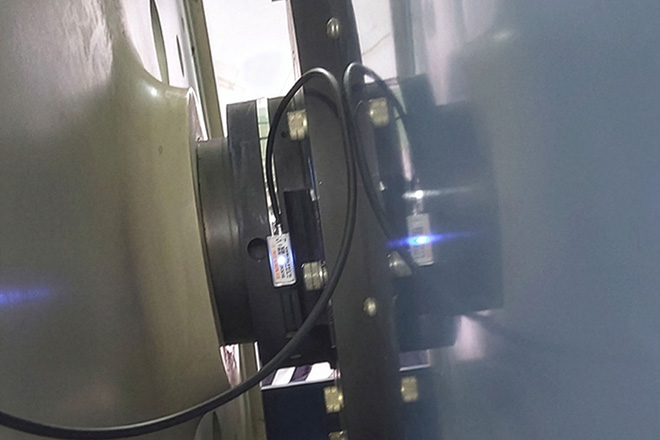 RESOLUTE encoder readhead in-situ on the roll axis of the telescope
Example application
An one-meter telescope located in an observatory at an astronomical research facility was installed in 1971. It later began to suffer performance issues due to ageing components such as bearings, motors and position feedback encoders.
To resolve these challenges, Renishaw's local distributor recommended upgrading to two RESOLUTE absolute encoders with 32-bit resolution. Chosen for their robustness in harsh environments and ability to compensate for thermal expansion, these encoders were mounted on the telescope's roll and pan axes, to provide precise feedback for orientation and lateral movement.
This upgrade significantly improved the telescope's performance. Reliable position feedback is essential for accurate star tracking and pointing operations, enabling the observatory to continue supporting high-precision astronomical research.
Gimbals for camera mounts
Gimbals are widely used in camera mounts for virtual reality (VR) and augmented reality (AR) content production.
A typical gimbal system consists of three main drive subassemblies: base, pan, and tilt. Each of these is equipped with direct-drive motors and angular position encoders.
This angular position feedback is essential for precise motion control and stabilisation, ensuring accurate pointing and tracking, so the camera remains focused on its target.
Example application
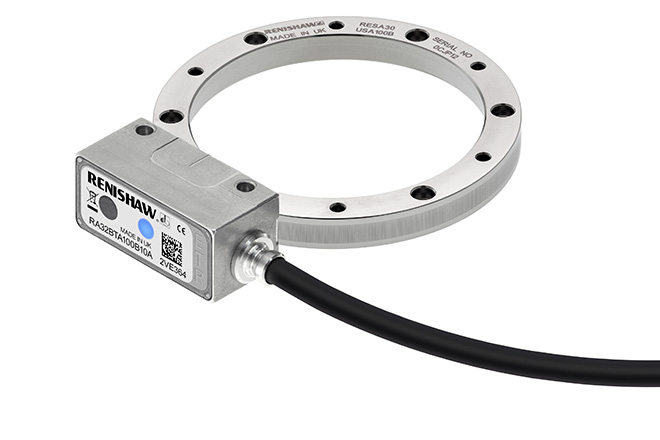
A US provider of encoded nodal heads for VR and AR camera position tracking employed Renishaws RESOLUTE absolute rotary encoders with RESA rings and 26-bit resolution on both the pan and tilt axes.
In special effects production, these heads help capture highly accurate camera position data, enabling seamless integration of virtual elements with real-world footage an essential requirement for AR and mixed reality productions. This ensures that virtual objects interact correctly with the physical environment.
The RESOLUTE encoder solution was chosen for its high precision, zero backlash, and ease of installation, supported by the ADTa-100 Advanced Diagnostic Tool which simplified set-up and calibration.
Renishaw absolute encoders enhance the accuracy and precision of camera support systems, enabling higher-quality immersive media broadcasts.
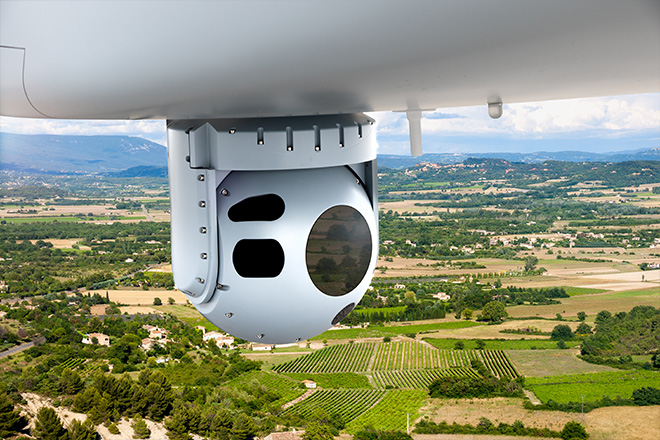
Camera gimbal mounted beneath an unmanned aerial vehicle
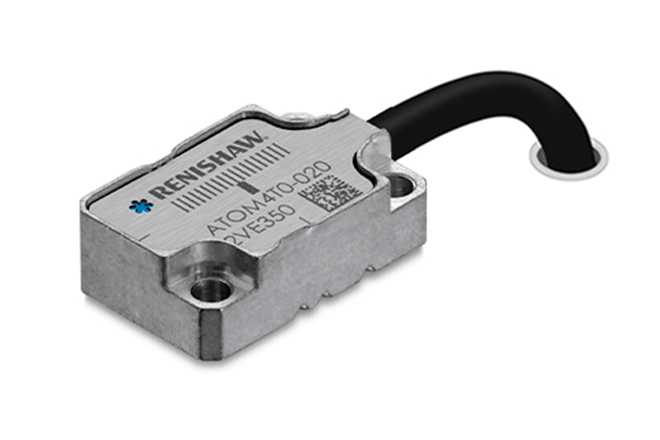
In other camera mount systems, ATOM™ miniature optical incremental encoders were chosen for their compact size, signal stability, and reliability.
Gimbals in stabilisation platform for UAV imaging
Compact stabilisation systems for cameras and sensors designed for high-precision imaging and laser targeting applications are particularly suited to small UAVs.
A typical gimbal platform includes a support frame, platform, and isolation array. The array resists linear movement more effectively than rotation, providing passive isolation against linear motions.
The platform also incorporates an active drive system and control electronics for enabling precise motion control and dynamic damping. Position encoders measure the platform's angular positions about its rotary axes (roll, pitch, and yaw), enabling real-time adjustments to maintain stability and accurate orientation.
Combined with data from an Inertial Measurement Unit (IMU), the feedback from the encoder gives a complete picture of the platform's motion and position relative to Earth. The control system uses this data to drive magnetic voice coil actuators, applying controlled moments and linear forces to the gimbal. This ensures the stabilisation system maintains a precise line of sight with a geographic position critical for imaging and targeting applications.
Inductive rotary encoders, such as Renishaw's ASTRiA™ series, are well suited to these applications, offering robust, lightweight, and compact position feedback with low power consumption.

Example application
In a gimbal application with a UAV camera system, RESOLUTE ETR encoders with RESA rings, 26-bit resolution, and BiSS® C serial communication were selected. The RESOLUTE ETR encoder delivers high-accuracy position feedback down to -40° C, ensuring reliable operation at high altitudes where temperatures are low - a performance independently verified by the customer through rigorous testing. Three RESOLUTE rotary encoders were installed on the pitch, yaw, and roll axes, achieving an accuracy of under 10 arc seconds. Renishaw's absolute encoder system provides the precision required for demanding UAV imaging and targeting tasks.
Summary
Position encoders are integral to the functionality and precision of gimbal systems across various applications, including radar systems, optical telescopes, and imaging platforms. By delivering accurate angular position feedback, encoders enable precise control and stabilisation of payloads in gimbal applications, ensuring reliability and high performance in demanding environments.
In radar systems, encoders enhance object detection and classification accuracy. For optical telescopes, they ensure accurate alignment and tracking of celestial objects. On imaging platforms, encoders help to maintain stable and focused targeting, even when the platform is disturbed.
Renishaw offers a comprehensive range of encoder solutions tailored to these needs. Open optical encoders are designed for applications requiring the highest precision. Inductive encoders provide robust, high-performance position measurement in challenging conditions. Magnetic encoders deliver lightweight, compact solutions where space and weight are critical.
Customers are encouraged to contact Renishaw's experienced sales and technical support teams to identify the best encoder for their specific needs.
 Large array radio telescope
Download the PDF


Contact our sales team today
Get in contact with your local office to find out more information and speak to an expert.